
Upcoming Online Public training opening November 5, 2026
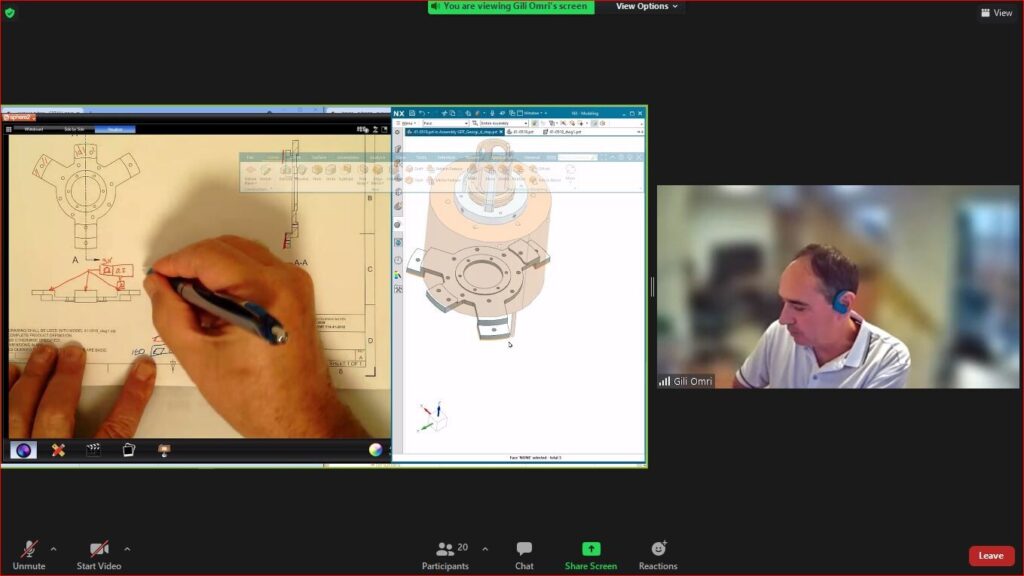
5 Zoom sessions,5, 9, 11, 13, 16 of November
4 hours per day, between 11AM – 3PM EST (GMT-05:00)
Training will be given in English
Price per person: $895
A 10% discount will be given for two enrollments or more from the same company.
To get the discount please send us an email: info@tes-tec.net
For more information about this training – contact us
Can you provide a quantitative basis for your engineering decisions?
Watch this 90-second demo to see how Stack-Up Analysis solves critical assembly challenges.
Course Description
Tolerance stack analysis is actually the study of the mutual relationship between the allowed deviation limits between parts and assemblies. Stack computation improves understanding of the design solution, allows early identification of problems starting while still in the design stage, forms the basis for decision making and is used to optimize tolerances to reduce costs and enhance benefit.
The course provides the theoretical knowledge and practical know-how to perform stack computation and includes heavy practical exercises of generic problems, exercise and full solution of real problems (the possibility of applying exercises to parts and assemblies of your company is contingent on previous submission of drawings and assemblies). This is an advanced GD&T course.
Course Content
- • Introduction and tolerance-stack computation definitions
• Principles and rules of stack computation
• Tolerance diagram
• Tolerance stack – casting and concentricity (part, assembly)
• Tolerance stack – profile (part, assembly)
• Tolerance stack – position
• Tolerance stack – position with material conditions – bonus and shift (part, assembly)
• Tolerance stack – form (Feature, FOS, Feature-of-Size)
• Tolerance stack – orientation (Feature, FOS)
• Integrated tolerance stack computation (part, assembly)
• Application of tolerance stack computation to tolerance optimization
• Summary practical exercise - Prerequisites:
• Knowledge of and experience in reading technical (engineering) drawings
• Good knowledge of Geometric Tolerances
Certificate of completion will be issued to registrants who successfully attend and complete the course
Course Outcomes: what’s in it for me? - Execute 1D Stack-Ups: Perform systematic, spreadsheet-based linear tolerance analyses on parts and complex assemblies.
Audit GD&T Definitions: Identify and rectify incomplete or ambiguous geometric specifications to ensure design intent.
Map Tolerance Chains: Establish and solve dimensional loops to determine the cumulative impact of variation on functional requirements.
Mitigate Dimensional Risk: Quantify potential assembly failures and optimize tolerance allocations to improve manufacturing yield.
Validate Specifications: Verify that datum reference frames and geometric controls are mathematically and functionally sound.
Calculate Geometric Modifiers: Integrate “bonus” and “datum shift” (MMC/LMC) variables accurately into tolerance stack models.
- Materials Provided:
• 20 hours of online instructor-delivered Training
• Tolerance Stack (spreadsheet based) Application
• Course Notes (downloadable, .pdf\’s)
• 90 days of online single-user access
• Online learning assessment
• Instructor follow up to your content questions
Target Audience
The course is targeted for mechanical designers, production engineers and quality assurance personnel.
Insractor:
Gili Omri:
GD&T\GPS expert, developer of the “TES Method” which is a straightforward, practical approach and workflow to write and interpret geometric product specifications, Align Functional Requirements as determined by Design Intent, with clear Unambiguous geometric variation limits.
Certified ASME (American Society of Mechanical Engineering), Senior GDTP -S .
Delegate of Israel in ISO GPS committee (specifications and validation), Technical expert in the following ISO TC213 work groups: WG2, WG12, WG17 & WG18.
Developed and delivered GD&T (ASME) and GPS (ISO) training programs to engineering, manufacturing, and quality personnel at various industries including aerospace, defense, automotive, medical, print, industrial, and consumer products. focused on functional constraints and the interdependent relationship between design, production and quality. The training has proven its effectiveness and is delivered to small, medium, large international companies .
*Opening date depends on sufficient enrollment.