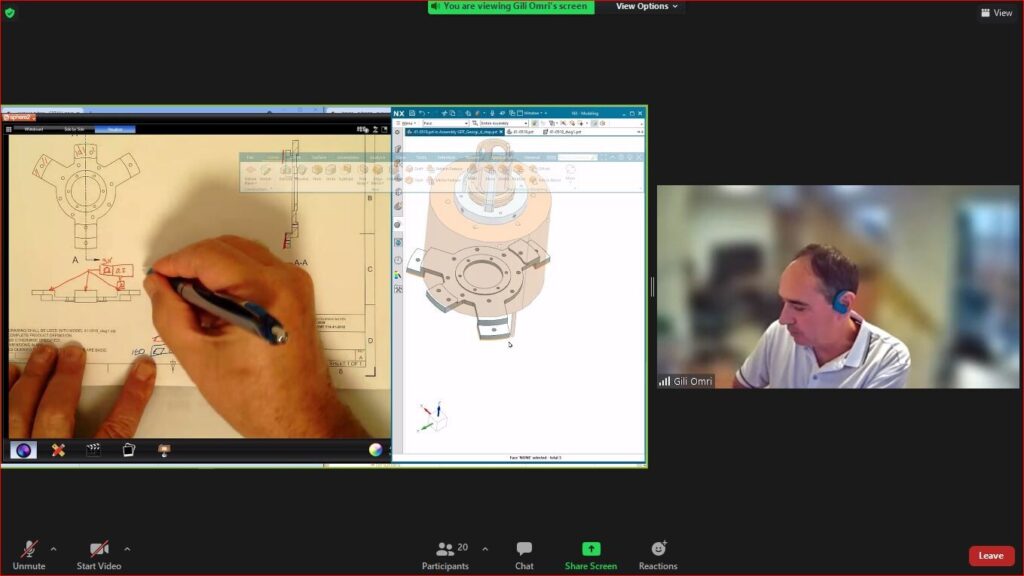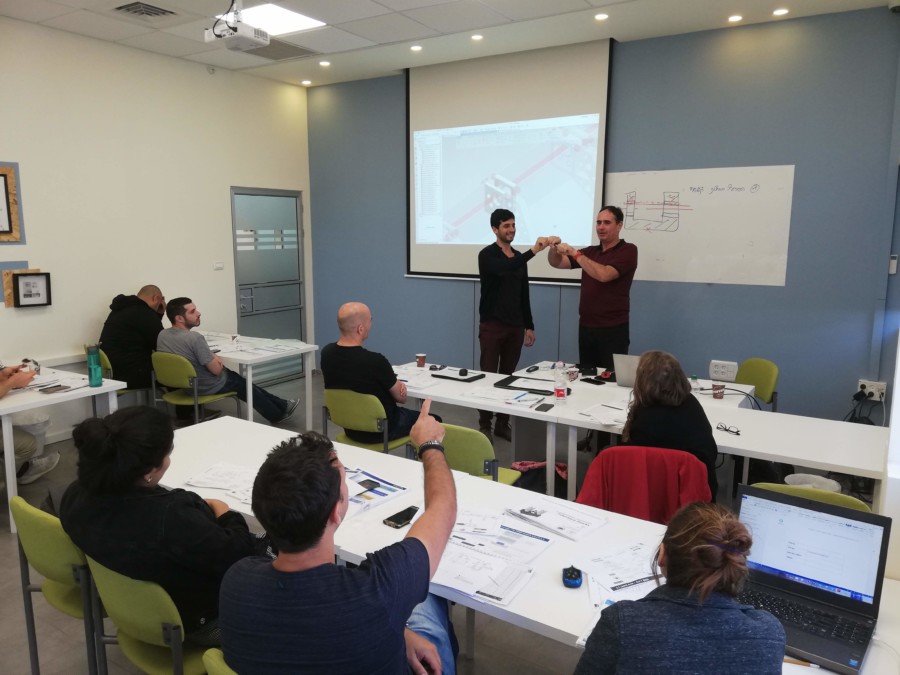

For Design, Production and QA Engineers
To schedule GD&T/GPS Online training for your team
Contact Us
Course focuses on useability of the Geometric tolerancing standards , introducing a straightforward, practical approach & workflow to write and interpret geometric product limits aligned to design intent with clear unambiguous variation.
The course covers
- Datum systems: datum feature precedence, datum feature variation limits.
- Location specifications: Position, Coaxiality, Symmetry, Runout, Total Runout, Surface Profile & line Profile.
- Orientation specifications: Angularity, Perpendicularity, Parallelism.
- Form specifications: Flatness, Straightness, Cylindricity, Circularity.
- Application of Material Modifiers to mitigate risk of scraping functional parts.
- Feature Groups and Patterns: Tool selection to best control variation (Position, Profile).
Course Outline
Five online meetings between 09:00-13:00 Eastern Time (GMT-04:00)
Course and exercises are based on practical examples, presubmitted participant’s models and drawings may be also embedded in the course.
Target Audience
The course is targeted for mechanical designers production engineers and quality assurance personnel.
Course Instructor
Course developer and instructor, Gili Omri is a seasoned R&D engineer with vast mechanical product development experience in Aerospace, Defence, Automotive, Medical devices and consumer products.
Mr. Omri is a certified senior ASME Y14.5. and a participating member and Technical expert of ISO\TC 213 commity.
Dimensional management Mentor, trainer & consultant.
Tolerance variation and accumulation expert.
Syllabus
Introduction:
- Why are geometric variation limits (tolerances) needed,
- ASME GD&T ISO GPS Standards
Terminology:
- Feature
- Feature Of Size
- MMC \ LMC
- Envelope
- Size deviation & Fit system
The TES Method:
Map Functional requirements to Geometric specifications Workflow.
Datum Systems (Datum Referance Frames)
- Datum Features selection
- Material Conditions
- Datum Targets
Form:
- Flatnes (Integral, Derived)
- Straightnes (Integral, Derived)
- Circularity
- Cylindricity
Orientation:
- Angularity (Integral, Derived)
- Perpendicularity (Integral, Derived)
- Parallelism (Integral, Derived)
Runout
- Total Runout
- Circular Runout
Location
- Position
- Applicable modifiers (Material conditions, Projected)
- Groups & Patterns
- Concentricity & Symmetry
Profile
- Surface & Line profile
- Unilateral specifications
- Groups, Patterns
- Profile as General Tolerance
ISO-GPS Vs. ASME GD&T Review
- Fundamental Rules & Definitions
- Similarities and Differences
Prerequisites:
Practical engineering drawings experience
For details about a GD&T/GPS course, please fill out the form below
Certifications